


Green makes a city livable. A tree that provides shade on a hot day, a park where you can take a moment to relax, or a patch of grass where children can play — these are small things that make a big difference. More green also protects us against floods, mitigates heat waves, and contributes to healthier air and to our mental well-being.
How do we make the city better able to withstand extreme weather conditions? How do we ensure that de-paving and greening do not remain isolated efforts, but become structurally embedded in how we organize our public space? With the Taskforce De-paving project within the Leuven Climate Contract, Leuven 2030 aims to help guide greening efforts
Working together for maximum impact
In 2024, Leuven 2030, as part of the breakthrough project Taskforce De-paving, mapped where in Leuven the greatest potential for de-paving exists. This was done together with the data and GIS service of the City of Leuven. It turned out that especially the City of Leuven and KU Leuven own many large hardened surfaces.
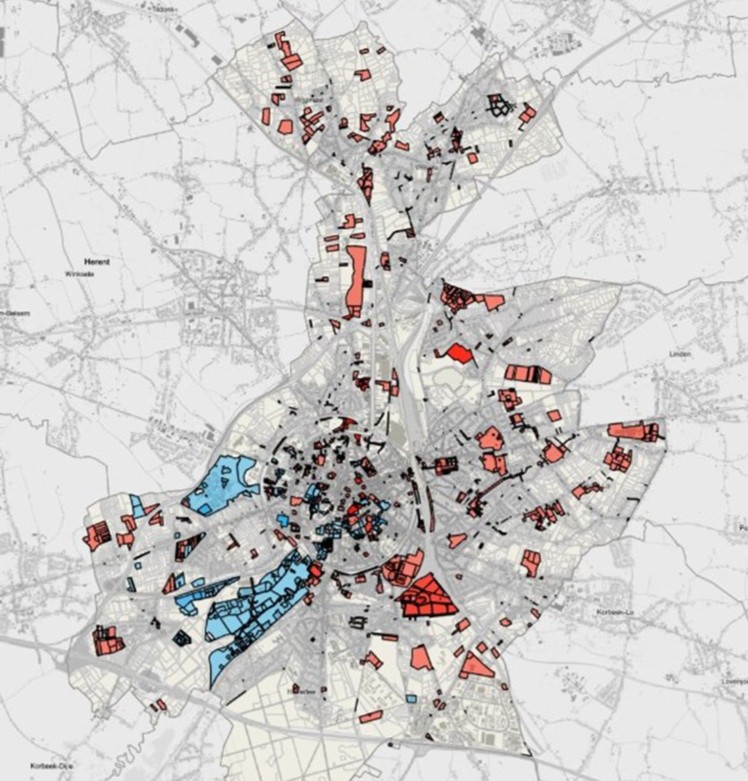
Instead of focusing on fragmented initiatives, we are working towards an area-based approach: collaborating where we can make the greatest impact. Since November 2024, Leuven 2030, the City of Leuven, and KU Leuven have been meeting regularly to develop a joint strategy.
From “nice to have” to a necessity
What is often missing is a clear framework: where are interventions most needed, and how can de-paving be linked to existing infrastructure and renovation works by default? Without clear priorities and budgets, climate-adaptive measures all too often remain something that’s “nice to have”. However, climate adaptation could also be seen as the starting point of new projects. Green and blue elements deserve a place at the drawing table, not only at the end of the process.
That’s why we are working with these two partners on a shared strategy that allows for targeted decisions: in which places does de-paving deliver the greatest social and ecological benefits? And how can we anchor greening in the policies of large landowners?
.jpg)
At the same time, we are outlining the risks of not acting. If we do nothing, heat waves and floods will occur more frequently and intensely. This not only causes discomfort but also real risks. Especially older people, young children, and people with health issues are vulnerable during periods of extreme heat. And damage from water, for example during heavy rainfall, can quickly add up to thousands of euros per incident, per home. By investing now, we build a city that is better prepared — and more pleasant to live in.
A shared ambition: 3-30-300
A useful starting point is the 3-30-300 rule:
- Every resident sees at least 3 trees from their home
- The city has at least 30% tree canopy cover
- Everyone lives no more than 300 meters from a green space
Both the City of Leuven and KU Leuven consider this rule a guiding principle in their climate adaptation policy. In the coming months, they will align their ongoing and planned projects to find actions that can reinforce one another.
Leuven 2030 as a connecting force
Leuven 2030 plays a key role in this process. As a network organization, we connect partners, facilitate knowledge sharing, and help bundle fragmented efforts into one focused approach. By working together with the City of Leuven and KU Leuven — the two largest landowners — we aim to achieve tangible results as quickly as possible.
Once the joint strategy is ready and priority zones are delineated, the collaboration will expand to other potential partners. Step by step, we are creating a Leuven where hardened surfaces make way for life: with more green, less heat stress, and a better quality of life for everyone.



In partnership with

Related breakthrough projects


Gerelateerde acties
