


.jpg)

Summer has not even begun yet, but once again climate change is increasing the risk of prolonged heatwaves across Europe. In cities, that means hotter days and nights, higher demand for cooling, and growing pressure on public health and infrastructure. A warmer atmosphere can also hold more moisture, increasing the likelihood of intense downpours and flash flooding.
- What does a scorching summer cost our health?
- What does flooding cost our infrastructure?
- What do rising energy prices mean for our businesses?
We often talk about the cost of the climate transition. Far less often do we talk about the cost of delay.
That is why, on 23 March, Leuven 2030 and the City of Leuven brought together around sixty CEOs, directors, board members and policymakers at De Hoorn for an evening of networking and reflection. As a network organisation, Leuven 2030 connects businesses, organisations, universities, colleges and publicauthorities around a shared challenge: making our city fit for the future. Together with the city and our partners, we are part of the European Mission for 100 Climate-Neutral and Smart Cities. In 2023, we launched the Leuven Climate City Contract: Leuven’s roadmap and financial strategy for achieving that ambition together.

The evening centred on risk management and long-term resilience. How do we protect our economy, infrastructure and prosperity in a changing climate? And what role can businesses, organisations and governments play?
The certainties we take for granted
You wake up in a comfortable home. After breakfast, you drop the children off and head to work. The train arrives on time. On the way home, you stop by the supermarket and choose from shelves that are fully stocked. Your energy bill appears on your phone, but you do not worry too much about it. It remains affordable.
Behind these everyday certainties lies a complex system of energy, infrastructure, agriculture and international trade. We have spent decades building that system, yet it is coming under increasing pressure.
Periods of drought can destroy harvests or fuel conflicts elsewhere in the world, driving up food prices. Heavy rainfall can flood streets, basements and railway lines. Homes lose value when they are repeatedly exposed to flooding.
As these shocks accumulate, the effects ripple through society. Costs rise and the things we rely on become less certain. That is why the climate transition is, above all, about looking ahead: limiting damage, safeguarding prosperity and preparing our city for the future.
Why cities are especially vulnerable to heat
As summer approaches, it becomes increasingly clear how vulnerable cities can be. Where concrete and asphalt dominate and greenery is scarce, heat lingers for longer. Streets and squares warm up, buildings struggle to cool down, and during heatwaves temperatures in cities can be several degrees higher than in surrounding areas.
Older people, young children and those living in lower-quality housing are affected most. Their bodies are less able to cope with extreme heat, while homes without proper insulation, ventilation or nearby green space heat up faster and cool down more slowly.
That is why creating more room for greenery and water in our city is not an aesthetic choice. It is a strategic investment in public health and quality of life. Trees, parks, gardens and permeable spaces cool urban areas and allow rainwater to soak back into the ground.
What does the risk assessment tell us?
During the evening, three speakers approached the same challenge from different perspectives.
Luc Bas, Director of CERAC – the Centre for Climate Change Risk Assessment – presented the Belgian Climate Risk Assessment.
The report offers a clear picture of the climate risks already affecting Belgium today. Rather than focusing on distant future scenarios, it examines tangible impacts on health, housing, infrastructure, the economy and food security. The report identifies 28 major climate and ecosystem risks, many of which reinforce one another. Heat, drought, infrastructure damage and economic disruption are deeply interconnected.
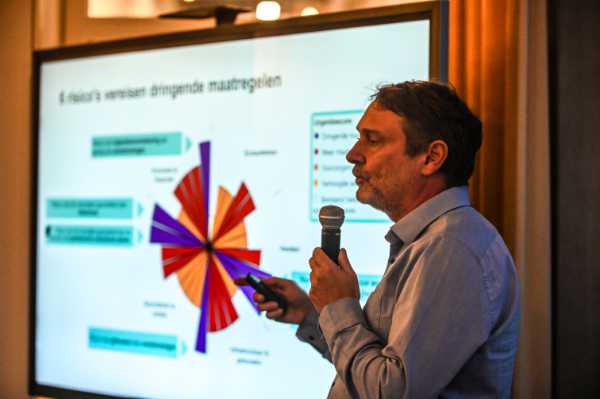
“CERAC’s mission is to help protect Belgium and make it more resilient to climate change. At present, Belgian policy is not yet sufficiently geared towards that objective. Leuven is taking important steps through its green plan, depaving initiatives, restored waterways and the creation of a dedicated depaving taskforce. But if we want to make a real difference, we need to increase both the scale and the pace of action.” — Luc Bas, CERAC
Climate change also affects people unequally. Lower-income households are more likely to live in homes that are difficult to keep cool, have less access to green space and possess fewer resources to protect themselves against rising costs or climate-related damage. Climate action is therefore not only about technology or carbon emissions. It is also about protecting vulnerable people and creating a fairer society.
Nature as smart infrastructure
For landscape architect Bas Smets, part of the solution lies in the way we design our cities.
Nature, he argues, should not be seen as decoration but as infrastructure. Trees, water and healthy soils can perform many of the same functions as technical systems: cooling cities, storing water and improving living environments.

“A crisis can also create an opportunity to move quickly and achieve a great deal in a short period of time. Climate change can be the catalyst that accelerates efforts to protect our cities against heat islands, flooding and drought."
"In Genk, we had the opportunity to transform a heavily paved city centre into a vibrant green space. There was remarkably little time between the initial idea and its implementation.” — Bas Smets
His work has received international recognition. Bas Smets was appointed Officer of the Order of Arts and Letters by the French Ministry of Culture and was recently nominated by Knack Weekend as Person of the Year 2025 for his ability to translate climate challenges into practical urban solutions.
Businesses and organisations that see opportunity
Businesses also have an important role to play in the climate transition.
Babs Dumont, Chief People & ESG Officer at Merkator Group and Chair of Leuven 2030, emphasised that climate action is about more than responsibility. It is also about opportunity. Companies can do more than comply with regulations and expectations: they can create new value. What begins as a response to external pressures can evolve into innovation and a stronger long-term business strategy.
“Tackling climate change, making a positive contribution, or helping your customers make a positive contribution can also be a sound commercial decision.” — Babs Dumont
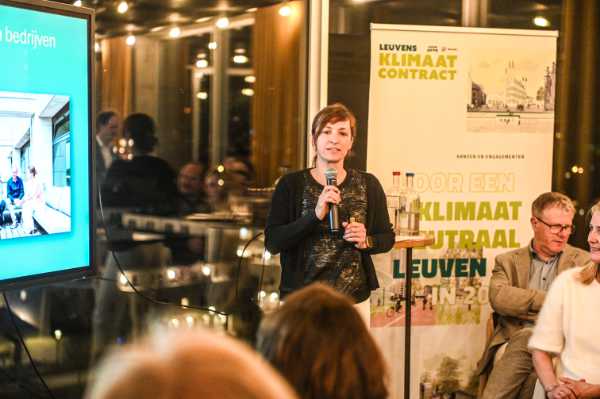
She illustrated this with the story of Merkator Group:
“Fifteen years ago, it started with a question from the insurance sector. Insurers wanted to assess natural risks more accurately and needed better data to do so. That led to the creation of Belmap, a data platform that maps Belgian property and address information with exceptional precision.
Two years ago, together with our new management team, we made the strategic decision to position Belmap as a platform dedicated to 100% positive impact.
We firmly believe that the true power of geodata lies in its ability to create positive change. Tackling climate change, contributing positively, or enabling your customers to do the same can also make strong business sense.”
Leadership for the future
“In uncertain times, people need something to hold on to. Strong leadership provides direction and perspective. It helps us look ahead again, sparks imagination and shows what is still possible.” — Mohamed Ridouani, Mayor of Leuven
This evening brought together Leuven’s decision-makers to sharpen the discussion, share insights and explore new collaborations. The next step is clear: turning those insights into action.
Anyone who carries responsibility within a business, organisation or public institution also holds the leverage to help shape tomorrow.
The climate transition is not a cost. It is a form of risk management. An insurance policy for our city. And like any insurance policy, it only works if enough people take part.

In partnership with

Related breakthrough projects

Gerelateerde acties
