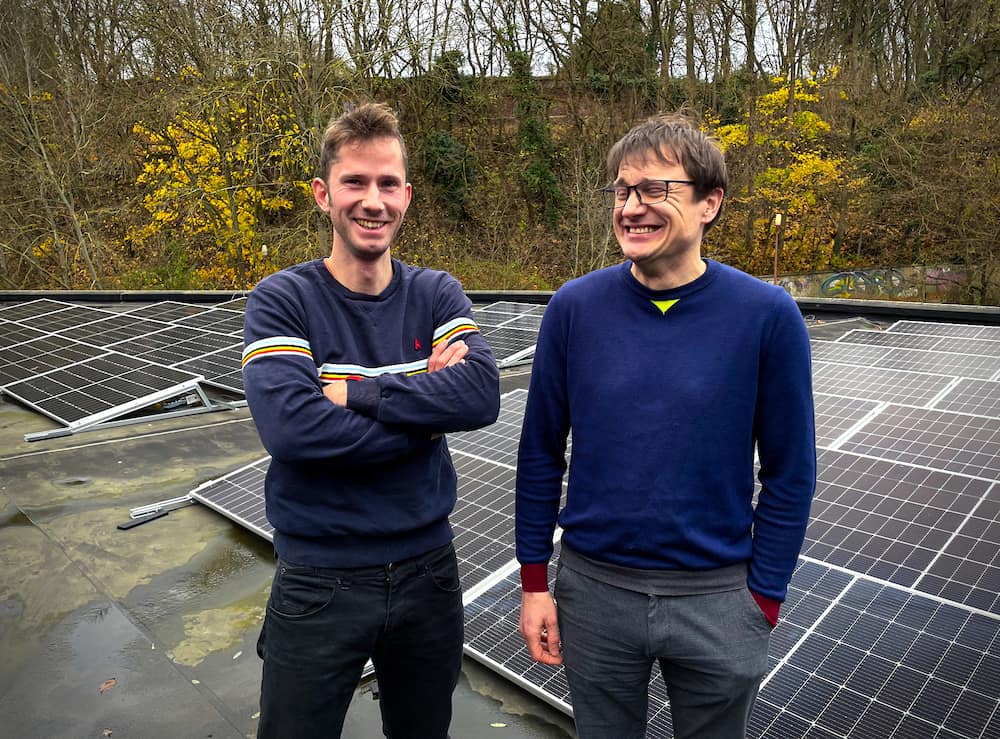
The installation of 110 solar panels on the roof of OPEK at the end of 2024 set an important precedent. The breakthrough project Solar Panels on Large Rooftops, led by Leuven 2030 and energy cooperative ECoOB, demonstrated that new forms of collaboration between building owners and energy cooperatives are not only possible, they're financially attractive. And since then, a lot has happened.
Here's a look at what we've been working on.
Smarter decisions through data
To focus our efforts where they matter most, we commissioned the data science team at Emergent Leuven in 2025 to develop a dedicated digital tool: the Leuven 2030 Solar Rooftop Dashboard. This application maps the solar potential of large rooftops across the city and ranks them by their possible CO₂ reduction. The logic is straightforward: the more rooftops covered with solar panels, the more local green energy we generate and the fewer emissions we produce.
.jpg)
Based on this analysis, we identified a shortlist of 200 buildings where solar installations would have the greatest climate impact.
New projects on large private rooftops
Armed with that list, we opened conversations with the owners and managers of the fifty most promising sites. Combined with spontaneous responses to the Leuven 2030 monthly newsletter, this led to concrete trajectories, together with ECoOB, at META Leuven, Monte Rosa, and the Don Bosco Centre. These solar installations, paired with battery storage and charging infrastructure, are currently in various stages of preparation or implementation.
On some of these larger sites, solar panels have also been installed without direct involvement from Leuven 2030 or ECoOB. Nick Meynen, account manager at Leuven 2030, explains: "Our approach often connects with processes that building managers have already started. Sometimes we provide that extra push toward execution; sometimes we help accelerate plans that were already in the works."
He also points to a broader shift in mindset: "International developments are increasingly motivating building owners to reduce their dependence on imported energy. Generating and storing your own power is a logical step toward greater autonomy and resilience."
Municipal buildings are taking steps too
In spring 2024, Leuven 2030 and ECoOB assessed the solar potential of a number of municipal buildings. The result: an implementation plan for four rooftops. The Bosstraat building and the municipal theatre (Stadsschouwburg) will receive new or expanded installations this autumn. The SLAC and the municipal depot will follow in 2027. The City of Leuven has chosen to develop these installations under its own management.
Looking beyond large rooftops
Our work on solar energy goes further than just large commercial roofs. Leuven 2030 also supported the city in the upcoming launch of a group purchase initiative: combining solar panels with battery storage, charging infrastructure, and heat pumps aimed at Leuven residents.
We're also actively exploring European funding opportunities to accelerate additional installations. In 2025, we helped the City of Leuven secure IRENE, a European project focused on energy poverty. Through the EU, we also obtained consultancy support on the barriers to sharing locally generated solar energy.
More details about the group purchase will be communicated by the City of Leuven in autumn 2026 a new opportunity for residents to participate in Leuven's energy transition more easily than ever before.
Looking ahead
In the coming months, work continues on additional buildings from the top-200 list. At the same time, sharing locally generated energy remains a key challenge. Where possible, we push for it, though progress here depends heavily on the regulatory framework at the Flemish government level.
"More and more, we're moving toward complete solutions. By combining solar panels, batteries, and electric vehicle charging, we create greater efficiency, lower costs, and more stability." — Nick Meynen, Leuven 2030
"We're also noticing a shift in how organisations think about this," Nick adds. "With the energy crisis looming in the background, it's becoming increasingly clear to businesses and organisations that moving toward renewable energy doesn't just make environmental sense, it also makes them stronger, more resilient, and better prepared for the future."
At a climate consultation with cultural partners in Leuven, Maarten Minne of OPEK summed it up well: "Thanks to the collaboration with Leuven 2030 and ECoOB, we're saving thousands of euros on our electricity bill."
That combination of financial benefit, ease, and peace of mind is already making a real difference today. Without any upfront investment of their own, buildings take on a new role: rooftops become power generators, aligned with the needs of the grid and ready for smart charging. Together with partners like ECoOB, Leuven 2030 remains committed to solutions that strengthen organisations while contributing to a healthy, future-proof city.


In partnership with

Related breakthrough projects