



Leuven is one of 100 European cities that have committed to accelerating towards climate neutrality. Delivering on that ambition requires action in many areas: renovating buildings, rolling out sustainable heating and strengthening the circular economy.
But projects often encounter the same barrier: financing.
Capital is available. Pension funds, insurers, banks and impact investors want to invest, and projects are ready to move forward.
Yet the two do not always find each other. Not because there is too little capital, but because that capital does not always reach the projects where it can have the greatest climate impact.
The Leuven Climate Fund aims to bridge that gap. It is a single financing structure designed to bring public and private capital together with projects that struggle to secure the financing they need.
Leuven 2030 and the City of Leuven have been developing the fund together with partners since 2023. With almost €860,000 in European support, that work is now entering an important new phase.
The first building block of the fund will launch in October.
European support through LIFT
The fund’s legal, financial and tax structures have now been developed. What remains is the transition towards actual operations.
The fund itself needs to be established, an investment committee needs to be created and concrete projects need to become investment-ready. This is precisely where support from the European LIFT programme – Leveraging Innovation and Financing for Transformation – will be used.
LIFT is managed by NetZeroCities as part of the EU Mission for Climate-Neutral and Smart Cities. It provides a total of €2 million in funding to three European Mission Cities.
The funding will not be used as direct grants for Leuven projects. Instead, it will help establish the fund and prepare projects technically, financially and organisationally.
Leuven’s project, FLIGHT – Funding Leuven’s Implementation of the Green, High-Impact Transition – will receive almost €860,000 in European funding.
Preparing individual projects involves several steps. Partners examine whether a project is technically feasible, what investment is required, which risks are involved and how the financing can be structured.
The aim is to bring projects to the point where enough information is available for an investment decision to be made.
At the same time, work continues on the legal and organisational structure of the fund itself.
From social renovation to sustainable heating and reuse
Within FLIGHT, this approach is being applied to concrete projects in three areas: social renovation, heating and energy, and the circular economy.
For social renovation, partners are exploring how renovation projects by social organisations can be prepared and financed when those organisations do not have enough resources to cover the full investment themselves.
In heating and energy, ECOOB is carrying out ‘50-degree tests’ in buildings across Leuven. During these tests, the temperature of the heating water is temporarily lowered to 50°C.
This shows whether the building can remain comfortably warm at a lower temperature and which adaptations may still be required. That is valuable information for organisations considering a heat pump, district heating network or another low-temperature heating system.
Concrete applications are also being explored within the circular economy. Work includes pre-sorting waste streams at UZ Leuven and examining the inputs for a plastics sorting line, as well as fibre recognition technology to improve textile identification and sorting.
Each project undergoes a technical and economic assessment that can form the basis for an investment decision.
The objective is always the same: to take a good idea far enough that there is sufficient technical and financial clarity to make financing possible.
Why bring projects together in one fund?
The Leuven Climate Fund starts from an observation made in the Leuven Climate City Contract: capital exists and projects exist, but they do not always connect.
Projects can create substantial value for society without generating the financial returns expected by the market. What is often missing is a structure that can bring public and private capital together.
Some projects can generate income or financial returns. For others, much of the value lies elsewhere: better buildings, lower material use, social benefits or a city that is better prepared for the future.
By combining different projects and sources of financing, the fund aims to create more room to finance projects with high societal value.
The Leuven Climate Fund therefore builds a bridge between available investment capital and climate projects.
The city takes on an initial share of the risk. This first-loss guarantee gives private investors greater confidence to participate.
A solidarity mechanism is intended to allow projects generating financial returns to also support projects with substantial social and climate impact but limited financial returns.
An investment committee will therefore assess each project not only on its financial return, but also on its climate and societal impact.
Residents can contribute too
Governments, businesses and financial partners are not the only ones who can help mobilise funding. Residents will have a role too.
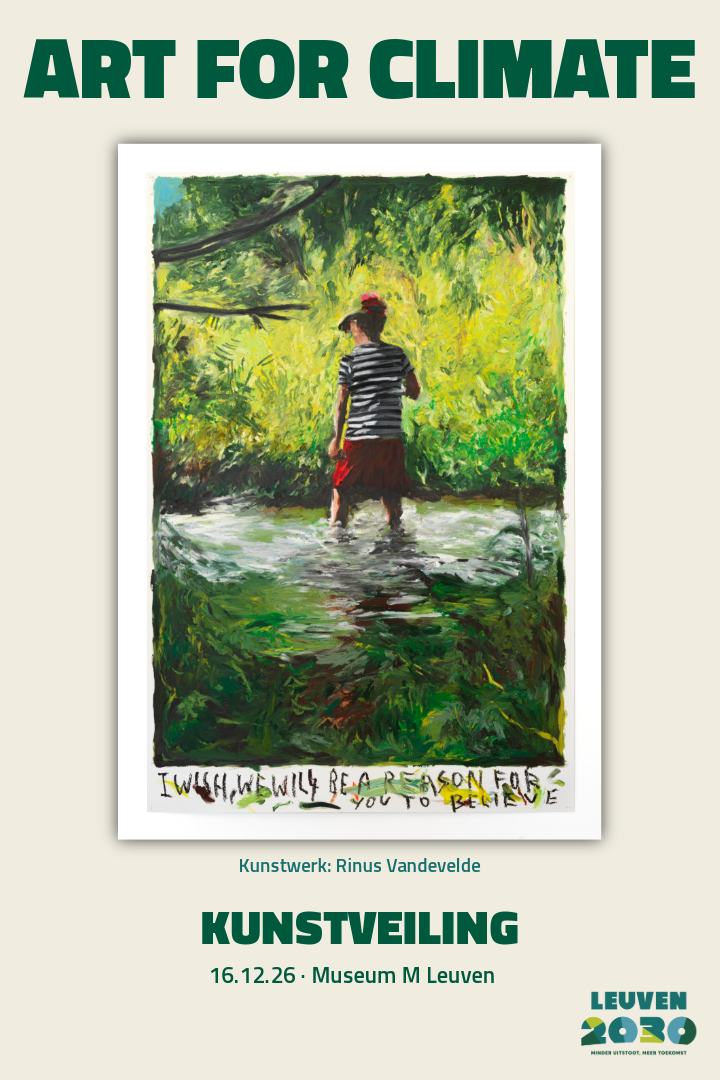
One first concrete example is Art for Climate, the art auction organised by Leuven 2030 at M Leuven on 16 December. Around 40 professional artists are donating a work of art or an artistic experience.
The proceeds will contribute to the Leuven Climate Fund.
Within FLIGHT, a model is being developed in which proceeds from the art auction could contribute to an interest-rate subsidy on loans. In this way, citizen capital can help make financing more feasible for projects that deliver significant value to society.
On a small scale, Art for Climate therefore demonstrates what the fund ultimately aims to achieve: bringing different types of resources together to move forward projects that would otherwise struggle to secure financing.
Turning a financing barrier into a lever
Innovation sometimes means being willing to take a leap before every detail is fixed.
The Leuven Climate Fund is an innovative model. But we are not jumping blindly. The model has been thoroughly prepared and developed from a legal and financial perspective, and we are building it together with strong partners.
Financing is a structural barrier to the climate transition. A technically sound project will not simply happen if the investment cannot be secured. And societal value does not always fit neatly into conventional financing models.
With the Leuven Climate Fund, Leuven 2030, the City of Leuven and their partners want to lower that barrier and create a lever for projects with significant value for society.
European support for FLIGHT allows us to work on two objectives at the same time: preparing concrete projects more effectively and building the fund that should ultimately be able to finance projects like them.
We also want to share what Leuven develops with other European climate cities through NetZeroCities and the network of 100 Mission Cities of which Leuven is part.
If the approach works in Leuven, it could be applied elsewhere too.
In October, we will launch the first building block of the fund.
→ Read more about the Leuven Climate fund
About FLIGHT
FLIGHT supports the further development of the Leuven Climate Fund and prepares concrete projects for financing.
The project consists of 14 work packages with a combined budget of €859,393.75. Its work includes social renovation, heating and energy, the circular economy, citizen capital and the further legal and organisational development of the fund.
FLIGHT is Leuven’s project within the Leveraging Innovation and Financing for Transformation programme (LIFT), managed by NetZeroCities as part of the EU Mission for Climate-Neutral and Smart Cities. FLIGHT is funded by the European Union through Horizon Europe.
This project receives financial support through NetZeroCities from Horizon Europe, the European Union’s research and innovation programme (grant agreement No 101121530).
.png)
.png)

In partnership with

Related breakthrough projects


.jpg)
%20Bjorn%20Snelders_lowres.jpg)