stad%20Leuven_header.jpg)

The recent heatwave was more than just a run of hot days. It became a stress test for the healthcare system, for our city and its residents, and a barometer of how well prepared we are for a changing climate. Moreover, not everyone paid the same price: people in vulnerable situations have far less access to air conditioning, gardens and water to cool down. As extreme temperatures become increasingly common, more green spaces, trees, shade and open water are becoming essential for a healthy and liveable city.
‘Normally, on a typical summer’s day, we have around fifty patients at emergency services at any one time,’ says Filip Camps, head nurse at UZ Leuven. ‘During the heatwave, we were seeing between eighty and ninety patients.’ According to figures from UZ Leuven, the number of patients arriving at emergency services also rose by around 15 percent during the heatwave. Furthermore, in a single day, nine deaths were recorded in the region by the regional Mobile Emergency Response Teams (Leuven, Tienen, Diest), either at home or on arrival. That is significantly more than we are used to, which is around one per day. “Of course, you can’t attribute every death directly to the heat. But such a difference does make you realise just how great the impact of a heatwave can be.”

Particularly for those who already have limited physical reserves, such an additional heat-related strain can be life-threatening. For Camps, the situation in this respect was reminiscent of the COVID-19 period. “Once again, it wasn’t usually young people, such as festival-goers, who were flooding our emergencies department, but vulnerable people, such as the very elderly and patients with underlying conditions,” he explains. People taking psychiatric medication are also at increased risk of overheating because they find it harder to sweat.
According to the emegergencies head nurse, the advice to drink extra water is not always straightforward either. “For people with severe kidney problems, this can actually make the situation worse. They really need medical supervision in such cases.”
Ice baths at the emergency ward
In severe cases of hyperthermia, doctors resorted to a treatment that had rarely been necessary in Flemish emegency departments: an ice bath. This brings the patient’s body temperature back down to 39°C as quickly as possible. “We saw people with a core temperature above 43°C. At that point, the brain, liver and other organs start to suffer damage. From that moment on, every minute counts,” warns Camps.
“In the space of three days, we administered around thirty ice baths,” says the emergency coordinator. “In my 26-year career as a nurse, I’ve never experienced anything like it. Even our senior management and healthcare staff from other parts of the hospital offered to help.”
Heat cannot be summed up by a single hot day
The heatwave at the end of June also shows just how deceptive heat can be. Anyone who sleeps poorly for several days, doesn’t drink enough or is already in poor health will gradually become exhausted. “Many people assume that the worst is over as soon as the temperature drops, but heat has a cumulative effect,” explains Camps. The impact builds up day by day. “On Monday, when the temperature had already dropped, we were still seeing a lot of patients.”
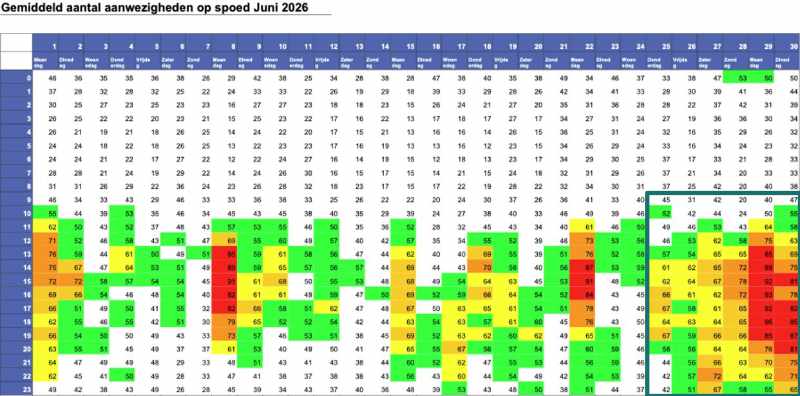
UZ Leuven’s internal ‘heatmap’, which the hospital uses to monitor occupancy on an hour-by-hour basis, also showed how the pressure persisted. “On a normal day, the map turns red for a few hours, after which the peak in the emergencies department subsides again,” explains Camps. “During the heatwave, that red zone remained visible almost continuously right up until Tuesday.”
Excess morbidity alongside excess mortality
According to Filip Camps, this persistent pressure illustrates why we should not focus solely on excess mortality. “Excess morbidity is at least as important.” By this he means the dozens of people who do not die but do become seriously ill, thereby placing enormous pressure on hospitals. “In emergency and the ambulance services, this has resulted in longer waiting times, the postponement of non-urgent operations, a faster throughput to general hospital wards, and ever-diminishing capacity to cope with unexpected situations. This may also increase the risk of misjudgements, as doctors have to divide their attention amongst more patients.”
According to Camps, the healthcare sector will have to prepare for this on a structural level if it is to continue to guarantee patient safety. “We had been warned, but my colleagues and I hadn’t anticipated such high numbers. In the short term, we are now working on a contingency plan for heatwave escalations, so that we are even better prepared next time.”
Research by VITO, the Flemish Institute for Technological Research, suggests that the pressure on the emergency departments during heatwaves will continue to rise in the coming decades. Based on hospital data, researchers estimate that heat during an average Flemish summer already accounts for around 2,390 additional emergency ward admissions. By 2050, that figure could rise to nearly 4,800 if global greenhouse gas emissions do not fall more sharply than currently expected. If the ageing population is also taken into account, the number of heat-related emergency admissions per summer rises to around 5,800. In that same scenario, the number of non-admitted contacts with emergency services would also more than double.
A difference of more than a few degrees
These predictions are in line with analyses by international climate scientists. According to them, without human-induced global warming, the recent heatwave in Western Europe would have been around 3.5 degrees cooler. “For the human body, those few degrees make a world of difference,” says the emergency expert. “Especially when the nights remain warm too, the risk of life-threatening heat increases significantly.”
But the heat does not affect everyone equally. Why does the same heatwave result in an uncomfortable week for one resident of Leuven, whilst for another it leads to a medical emergency? The answer lies not only in age or health, but also in one’s home, neighbourhood and social circumstances. Moreover, these factors often overlap. “Vulnerable people find it much harder to escape the heat. It is no coincidence that we have rescued far more people from high-rise blocks than from the detached-house neighbourhoods in Heverlee.”
A refuge during the heatwave
Freya Boelaert, general coordinator of De RuimteVaart, a Leuven-based organisation with a broad focus on poverty and exclusion, also recognises this inequality. During the heatwave, the community centre became a refuge for people who could no longer find relief from the heat at home.
‘We saw a lot of tired people,’ says Boelaert. ‘They’d been sleeping poorly for days because their homes were barely cooling down at all.’ Those living in flats, particularly on higher floors or just below the roof, had a particularly hard time. "Many people try to cope with such extreme temperatures using fans or portable air conditioners, but these don’t always provide sufficient cooling. With portable air conditioners, the drain hose also has to be fed out through an open window, which allows warm air to come back in.” Together with her ‘Energiesnoeiers’ team, De RuimteVaart is now investigating how it can support vulnerable residents of Leuven next summer with simple and affordable sun protection.
%20(1).jpg)
Just how important it is for people to have a place where others can keep an eye on them became clear when a visitor suddenly felt unwell. “Our staff were concerned and called an ambulance. It turned out afterwards that he had heatstroke. If he’d stayed at home on his own, things might have ended a lot worst.”
Prevention is becoming more important than ever
For Jules Vertriest, the world’s first climate doctor, who has now been working at the Department of Care for almost two years, the recent heatwave came as no surprise. His role is to help the healthcare sector better prepare for a changing climate by translating scientific insights into policy.
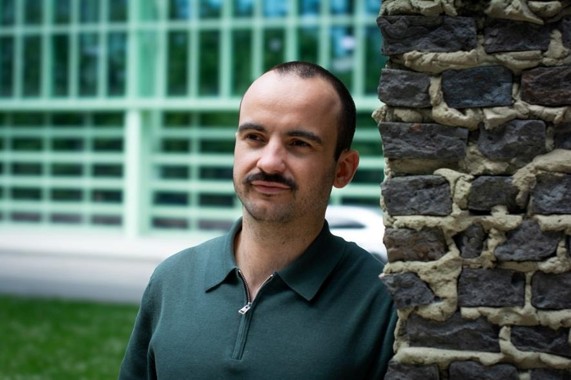
"If I had to name one consequence of climate change today that has the greatest impact on our health, it would be heat. Just look at Sciensano’s mortality monitoring: from 28 June to 1 July, there was a remarkable excess mortality rate of almost 40 percent in our country, with no other clear explanation for it other than the heat.”
In the case of a structural health challenge such as heat, he believes it is not enough to simply hand out extra water or activate a heatwave plan. “We must adapt to a climate that is already changing and becoming increasingly more extreme. Prevention is more important than ever.”
Where the heat hits hardest
We now have a fairly good understanding of who is vulnerable to heat stress. “Older people and those with chronic conditions such as COPD or cardiovascular disease are at greater risk of heat-related health problems. The same applies to people living in poorly insulated homes or in heavily built-up neighbourhoods with little greenery. The so-called ‘heat islands’ can become up to 8 degrees warmer than the surrounding countryside.”
However, for an effective prevention policy, it is equally important to know where the health risks are greatest. To identify these, the Department of Care has developed a heat vulnerability map. This shows, for each statistical sector, where the health risks are greatest and which factors contribute to them.
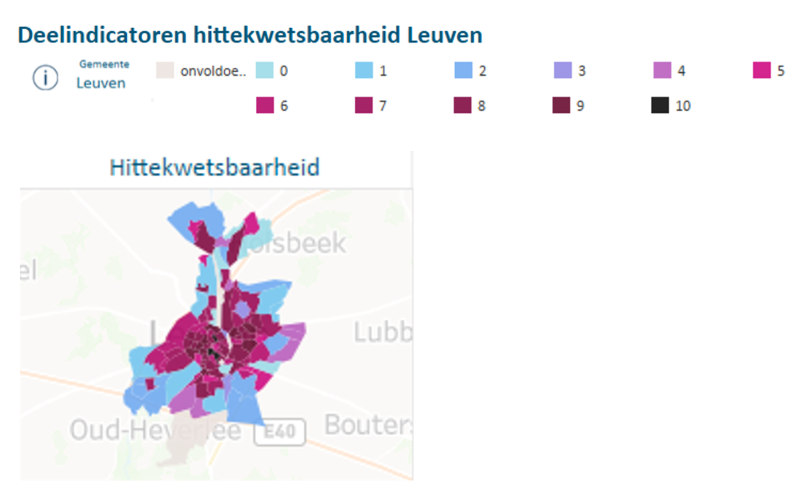
‘The map not only shows which neighbourhoods have the greatest needs, but also why. Is there a lack of green space? A lot of hard surfaces? Do a notably high number of older or vulnerable residents live there?’ This information should help cities and local authorities to take targeted measures, both in the short and long term, where the need is greatest. ‘Every heat-related hospital admission that can be prevented in this way is a win for the individual and for our society.’
Infrastructure as part of the solution
According to Vertriest, indoor heat resilience begins with what is known as the ‘the Ladder of Cooling’. “On hot days, first and foremost, you need to prevent heat from entering. Think of external sun blinds and a smart ventilation strategy: during the day, windows remain closed if it’s warmer outside than inside, whilst in the evening and at night, when the outside temperature is lower than inside, you open them just a little.”
However, such measures are not equally feasible for everyone. “Older people or those with reduced mobility cannot simply open and close all windows and shutters several times a day,” notes Vertriest. Neighbours, family members and informal carers then play an important role by checking in regularly to see if everything is alright.
But however important social networks may be, heat primarily calls for structural solutions. “Cities need far more shade provision outdoors, such as trees and other vegetation, canopies and shade sails over playgrounds, bus stops and squares where large numbers of people gather.”
Cooling centres also deserve more attention in the short term. “In cities such as Ghent, Kortrijk, Sint-Niklaas and Wetteren, residents can use a local map to see where they can find relief from the heat during a heatwave for example, in buildings with air conditioning, drinking water and toilets. Such initiatives can help vulnerable people get through hot spells safely.”
Looking beyond the next heatwave
But according to Vertriest, the greatest benefits lie in the longer term. “Many existing hospitals, care homes and older buildings were designed for the climate of several decades ago. For new builds and renovations, criteria for heat-resistant construction do already exist, and this is something we must continue to prioritise.”
The design of public spaces also plays a crucial role in this. “Large areas of tarmac and concrete absorb a lot of heat during the day and release it again at night, meaning neighbourhoods can barely cool down.”
That is why he advocates for more de-paving of squares and car parks, retaining rainwater for longer via wadis (infiltration facilities such as green ditches) and introducing more greenery into the streets. Various initiatives are underway in Leuven, including as part of the Leuven Climate Contract, under which Leuven 2030, through the flagship project ‘A De-pavement & Urban Greening Taskforce’, is working alongside the City of Leuven and KU Leuven to increase de-paving and greening. In recent years, the city has also drawn up a Green Plan and a Strategic Tree Plan.
“A combination of trees, shrubs and other vegetation works best. This creates shade and cooling through evaporation, without the heat becoming trapped beneath a dense canopy.” Such measures not only limit the impact of heat, but also make cities more resilient to other consequences of climate change. “Think of extreme drought, flooding, a longer pollen season, the spread of exotic pathogens and their vectors, and even wildfires. In short, climate measures are not a cost, but a necessary investment in health,” emphasises Vertriest.
It is certain that the recent heatwave will not be the last. But the extent to which extreme heat affects our health is also determined by the choices we make today: about how we build, how we design our public spaces, how we organise our healthcare, and how we invest together in a healthier, more resilient and liveable city for everyone.
Author: Trees Vandamme
In partnership with

Related breakthrough projects


Filip%20Van%20Loock%20(4)%20(1).jpg)