


.jpg)

In mid-November last year, the GREEN-LOG pilot project got underway in Leuven. As part of this European-funded initiative, food surpluses from local shops and traders were collected free of charge by cargo bike and redistributed to social organisations, such as neighbourhood centres, schools, youth welfare services, and social restaurants. In Leuven, the project was coordinated by Marij Lambert of the City of Leuven, in collaboration with SAAMO Vlaams-Brabant, urbike Leuven, and Leuven 2030.
"With this project, we're testing smart logistics solutions for urban environments, but it was equally important to us to tackle a broader social challenge, not just a logistical one. Collecting food surpluses turned out to be a perfect fit for the unpredictable, last-minute transport requests we were looking for. By getting healthy food to social organisations quickly and efficiently using sustainable cargo bikes, we're contributing both to more climate-friendly transport and to better access to food in our neighbourhoods." — Marij Lambert, City of Leuven
Rising food costs: a real and growing problem
The rising cost of food is a genuine problem today, particularly for people with limited financial means. Through the European FEAST project in Leuven, Leuven 2030 and its partners are working to make healthy, sustainable food choices accessible to everyone. One way to offset the impact of rising food prices is to make better use of surpluses for instance, in social neighbourhood restaurants that offer meals at affordable prices.
But that approach runs into practical barriers. Food surpluses are unpredictable. They need to be collected quickly. And they often only become available after shop closing hours. Picking them up yourself takes time, staff, and transport which are scarce resources for many social organisations.
That's the problem this project set out to solve: a system that collects and distributes last-minute food surpluses quickly, efficiently, and sustainably without placing extra pressure on either traders or social organisations.
What did GREEN-LOG test in Leuven?
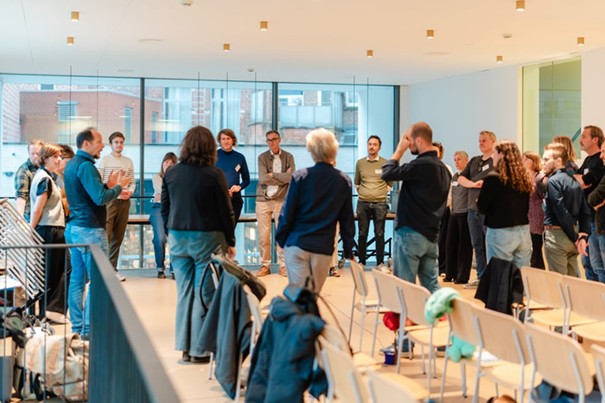
The Leuven pilot ran from 17 November 2025 to 20 March 2026, building on an idea that first emerged two years earlier at a Leuven 2030 Urban Lab networking event. During that session, the City of Leuven and SAAMO Vlaams-Brabant explored a core question together: how can food surpluses in the city be redistributed more quickly, more smartly, and more sustainably?
That exercise made one thing clear: this isn't one big problem, it's a cluster of smaller ones. How do you redistribute food in a way that's safe? How can participating shops signal quickly and easily when they have surpluses? And who is best placed to get that food to the people who actually need it?
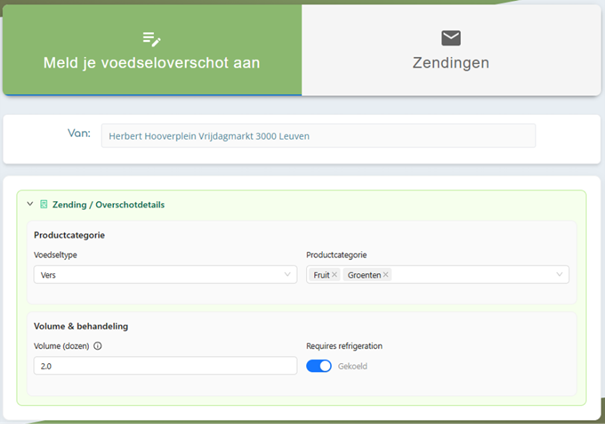
Those questions became the foundation for the Leuven GREEN-LOG pilot. Participating shops, stores and caterers could use a digital logistics platform on weekdays to indicate when surpluses were available. Collection requests were then bundled into smart, efficient routes handled by cargo bike.
"This system also gives us the assurance that our surpluses end up where they need to be, in a food-safe way." — Tine Roelant, De Broodenier
.jpeg)
"The project was a real added value for us because it helped us keep our food costs down." — Sven Schroeders, Buurtwerk 't Lampeke
Results of the pilot
Over the three-month test period, 10 local traders committed to donating their surpluses. The results:
- 66 collections carried out with zero-emission cargo bikes
- 354 crates of food rescued
- Nearly 1.4 tonnes of CO₂ saved (indicative estimate)
- 11 social organisations reached
The climate gains came on the one hand from food that would otherwise have gone to waste was saved, and on the other hand from 189 kilometres of diesel delivery trips which were replaced by cargo bike rides. While these are cautious estimates, the figures clearly demonstrate the potential of this approach for sustainable and socially responsible urban logistics.
From a social perspective, the project also proved its worth. The surpluses included a welcome variety of vegetables, fruit, meat, and fish. Products that tend to carry a higher price tag and are therefore harder to access for people on tight budgets.
.jpeg)
What worked well and where were the limits?
Data from the digital logistics platform and conversations with partners - including urbike Leuven, social organisations, and traders - revealed a clear picture of what worked and what didn't.
On the positive side: the platform made it possible to register surpluses at the last minute and bundle multiple collection requests into smart, efficient routes. Direct delivery without intermediate storage proved workable, and collaboration between suppliers, the platform, the logistics provider, and social organisations ran smoothly. Food safety was never a stumbling block: the right certifications and clear agreements ensured deliveries were handled correctly throughout.
.jpeg)
At the same time, the experiment exposed some genuine limitations. Volumes were small, partly because existing initiatives like food-saving app Too Good To Go had already captured part of the surplus stream. Volumes also fluctuated considerably. The lesson: technology alone isn't enough. Without sufficient volume, bundling becomes difficult, and the efficiency gains don't materialise.
The short duration of the project was also a constraint in itself. Social organisations need predictability, fixed volumes and regular time slots to help them plan. Building a sustainable partnership, bringing more suppliers on board, and covering couriers' wages all require structural solutions that go beyond the short-term logic of one-off subsidy projects. Still, the pilot showed that the model works and that the potential is real.
What are the next steps?
The GREEN-LOG pilot has now concluded. The partners involved are currently exploring whether and how the project can continue. A promising next step would be a longer-term collaboration model, in which partners and sponsors commit for a medium-term period (around three years) to further develop and scale the initiative.
Are you a shop or store owner or caterer interested in joining a follow-up project? Would you like to contribute financially in exchange for your logo on the cargo bikes in a possible next phase? Get in touch with urbike Leuven and SAAMO at info.vlaamsbrabant@saamo.be and help build social impact, sustainable logistics, and smarter cities.

This project is co-funded by the European Union and forms part of the CIVITAS initiative. It is a collaboration between the City of Leuven and GREEN-LOG, Urbike Leuven, Saamo Vlaams-Brabant and Leuven 2030.



In partnership with

Related breakthrough projects


.jpg)
.jpg)
