.jpg)

In the village of Attenrode lies a farm that, at first glance, may seem much like any other: a place where people work the land, crops grow and the seasons set the pace. Yet behind this familiar setting lies an extraordinary artistic ecosystem that is steadily evolving into a breeding ground for sustainable initiatives, experimentation and connection.
The driving force behind this movement is Sara ten Westenend—a visual artist, educator and culinary pioneer. Her story is one of exploring the origins of food, the role of art in society, and the potential of a working farm as a place of learning for future generations.
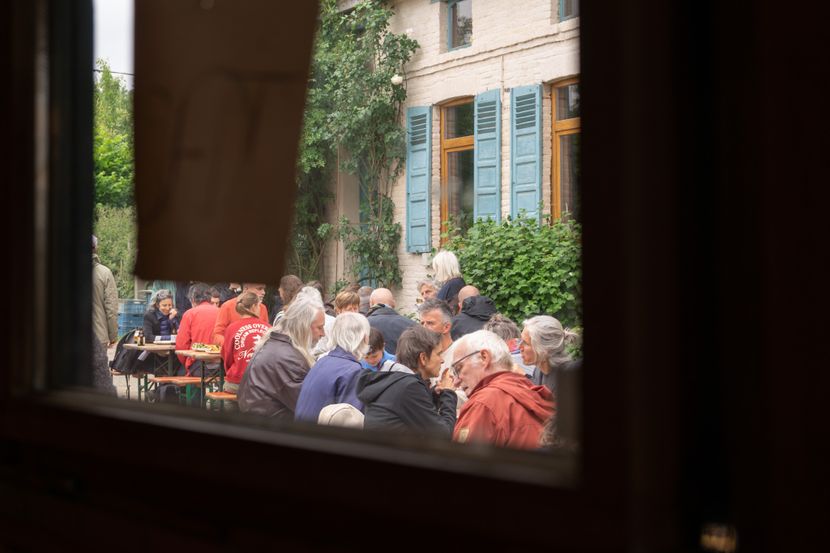
From Amsterdam to Attenrode: When Art Takes Root in the Soil
Sara studied at the Gerrit Rietveld Academie in Amsterdam. Art was her first language, but cooking has always been a parallel thread running through her life.
"Cooking, art and food have always gone hand in hand for me."
She began by providing catering for museums in the Netherlands before moving into the cultural sector, working for organisations including Ancienne Belgique and Opera Ballet Vlaanderen. Throughout those years, food and creativity continued to intersect in her work.
Still, one question kept returning:
"Where does the food I cook actually come from?"
She found her answer when she met Maarten, an organic farmer. His farm became the starting point for a new artistic and ecological journey. Instead of focusing solely on cooking for people, Sara began looking at the soil, the seasons, the labour behind farming, and the realities of food production.
It was a revelation.
She discovered that a farm is much more than a place where food is grown. It is a space where art, ecology, sensory experience, social interaction, storytelling and visions for the future all come together. It is a place where people can experience what food truly represents—not only as a production process, but also as a cultural and human value.
The Farm as an Artistic and Ecological School
In 2021, Sara launched her ongoing project You Hunter You, an invitation to relearn how to observe, feel, listen and navigate by instinct.
Each year introduces a new chapter. Nothing is predetermined; every edition grows organically from what the place itself and its participants bring to the process.
This approach reflects Sara's artistic philosophy. Art is not something to consume, but an experience in which everyone takes part. Participants are not spectators, she explains, but co-creators.
A Summer of Experimentation: Celebrating 160 Years of the Farm
One of this year's highlights is a summer programme celebrating 160 years of the farm and 30 years of organic farmer Maarten.
From 8 to 12 July, the farm will host a festive and experimental week where art, food and short supply chains come together.
What can visitors expect?
- Daily workshops led by architecture students from KU Leuven Campus Brussels and other young makers. Roles are reversed as students become teachers, offering workshops on themes such as farm materials, textiles, ecology and personal food stories.
- Free participation in all workshops, with visitors only paying for lunch.
- Evening dinners prepared by chefs from the cultural sector, featuring vegetables harvested from the farm and neighbouring organic producers. Every meal celebrates the short food supply chain, with ingredients coming straight from the fields.
- An open social experiment where learning, eating and discovering happen together.
Although the week has yet to receive its official name, its ambition is already clear: it is a celebration of collaboration, sustainability and creativity rooted in the land.
A Farm That Teaches the Future
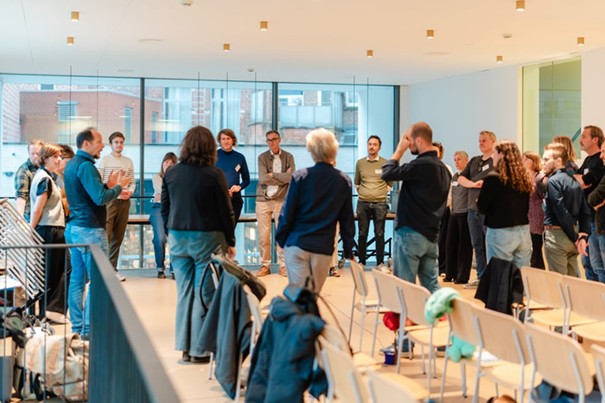
Sara collaborates with Lars Fischer and his architecture students at KU Leuven, who approach the farm as a closed ecological system—a place where living, working and agriculture continuously influence one another.
The farm becomes a starting point for broader questions:
- How do we build systems that remain in balance?
- How can we design infrastructure that evolves alongside its environment?
This connection between spatial planning, food production and ecology is both rare and urgently needed.
Students from countries including Brazil and Ukraine bring with them their own memories and experiences of farming and food. As a result, the farm has become an international learning environment where culture, ecology and architecture meet.
Collaborating with LOV2030
Sara was invited by LOV2030 to develop her own programme within LET'S EAT.
Together with the non-profit organisation NDRGRND (underground | ondergrond), she will further develop the idea of the farm as both a regional and international outdoor learning space.
Preparations are already well underway, and this summer's programme offers just a first glimpse of what is to come.
From 2027 onwards, artist residencies and new projects will gradually establish a long-term programme that will continue before, during and after LOV2030.
Autumn Programme: Loss, Biodiversity and a Dinner Among Stories
In October, the farm will once again become the setting for an event where art, ecology and humanity intersect.
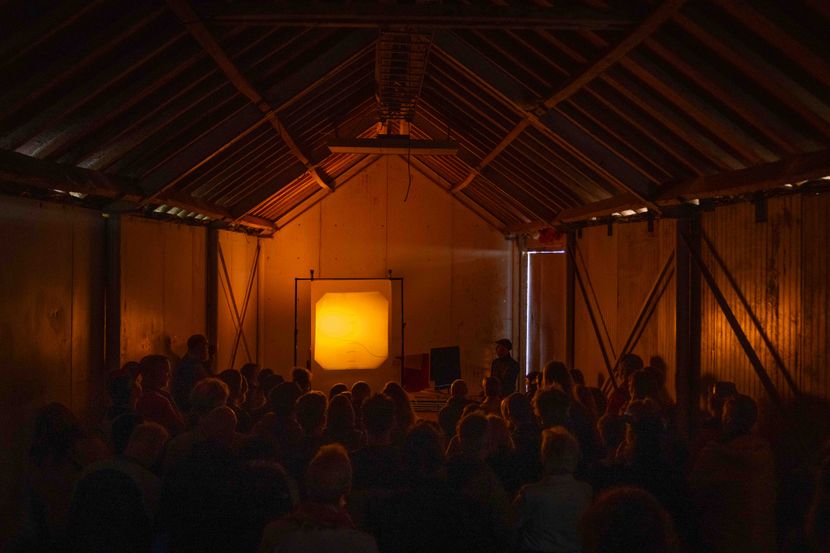
A musical and visual performance exploring dementia will be presented alongside a literary work reflecting on biodiversity loss. The artists themselves will introduce their work, each giving tangible form to a different experience of loss.
Here, two very different forms of loss meet in a powerful dialogue: the deeply personal loss of memory and identity, and the collective loss of species and ecosystems.
Visitors will share a meal at the farm, where each course becomes interwoven with the performance itself. Art and food will literally merge into one shared experience.
Short Supply Chains, Human Connection and the Importance of Small Things
Throughout our conversation with Sara, one message kept returning: our relationship with food is fundamental, yet too often disconnected.
Through its projects, the farm seeks to restore that connection through shared experiences, sensory engagement and awareness.
"We shouldn't strive for convenience—we should strive for something that is truly human."
That humanity can be found in the short food supply chain: organically grown vegetables with imperfections, apples you peel yourself, and menus shaped by the changing seasons.
It is equally present in collaborations between farmers, artists, students and local residents.
And it lies in recognising that an active organic farm—with all its challenges, hard work and realities—is not a museum exhibit, but a living ecosystem that depends on care, cooperation and commitment.
Looking for Collaborations
Alongside the summer programme and October event, Sara extends an open invitation.
Over the coming years, the farm hopes to strengthen collaborations with organisations and individuals working in the arts, education, social economy and sustainability.
Anyone who sees opportunities to contribute their expertise to this growing ecosystem is warmly invited to get in touch.
Contact: sara@ndrgrnd.be
A Unique Place in Flanders
As Sara beautifully puts it:
"There is no other farm so deeply connected to the arts as Boer Maarten in Attenrode."
The combination of agriculture, art, short food supply chains, education and sustainability makes this place truly unique.
It is a living laboratory for the future of community life—a place where your feet are in the soil, your hands are preparing food, and your mind is open to new ideas.
More information:
Co-funded by the European Union
FEAST is co-funded by the European Union's Horizon Europe research and innovation programme under grant agreement number 101060536. Views and opinions expressed are those of the author(s) only and do not necessarily reflect those of the European Union. Neither the European Union nor the granting authority can be held responsible for them.
UK participant in FEAST (Good Food Oxfordshire) is supported by Innovate UK grant number 10041509 and the Swiss participant in FEAST (FiBL) is supported by the Swiss State Secretariat for Education, Research and Innovation (SERI) under contract number 22.00156.

In partnership with

Related breakthrough projects


.jpg)
%20(1).jpg)
.jpg)
.jpg)